Morocco, Pt 3: Ouarzazate, Marrakech
Note: The Moroccan posts must be read sequentially. If you’re just arriving, click here for Part 1.
Ouarzazate
Something told me to go to Ouarzazate.
Maybe it was the film history there, or maybe to break up the drive from Merzouga to Marrakech. When I told Moroccans I was going for two days, they called me crazy: “You can do it in two hours!” But something told me to go, so I pressed on.
I booked an AirBnB called Le Jardin de Yuda. It’s located outside Ouarzazate, and was well-reviewed for its remoteness, its access to trails, and the amazing home-cooked meals provided by the host, Eric.
I had my reservations. I pictured I’d be staying alone with this total creep, eating our shared meals together with nothing to talk about, the only sound being crickets outside and the scraping of forks against our plates.
Well, that was not the case.
When I arrived in Ouarzazate, I was in a God-awful mood. My stomach was still on the fritz. I’d slept like crap in the desert. It was another eight-hour bus ride where I was dehydrated and had eaten only yogurts and protein bars. And when I arrived in this tiny town, parched and cranky, the driver was 20 minutes late to pick me up.
Ouarzazate is a small town. It’s called “the Hollywood of the desert” because many big-name films had been shot here, most notably Gladiator (hence the “Gladiator Cafe” or the many souvenirs or local tours related to it). Outside the movie studio, there is little to do. My driver eventually picked me up, and as we left the town we hit this high embankment. “You see that small town?” He asked me, pointing to a very tiny cluster of homes. “Eric’s is the village just beyond it.”
Eric greeted us at the door and my fears were assuaged. First, I learned he had two other guests arriving that night. And two, Eric seemed to be a legitimately cool dude.
He first showed me to my room. This was an adjoining guesthouse separated from the main house, and I had it all to myself — a large, comfortable bed, hot-water shower, real soap, and air conditioning. I was ecstatic. This would be my refuge.
It was about 5pm. I put my stuff down, then Eric and I sat for tea.
Eric’s in his late 50s or early 60s, I’d guess. He’s originally from France but has lived in Morocco over 23 years. He first worked at an NGO, then started his own. Apparently the dealings became too frustrating, so he stopped.
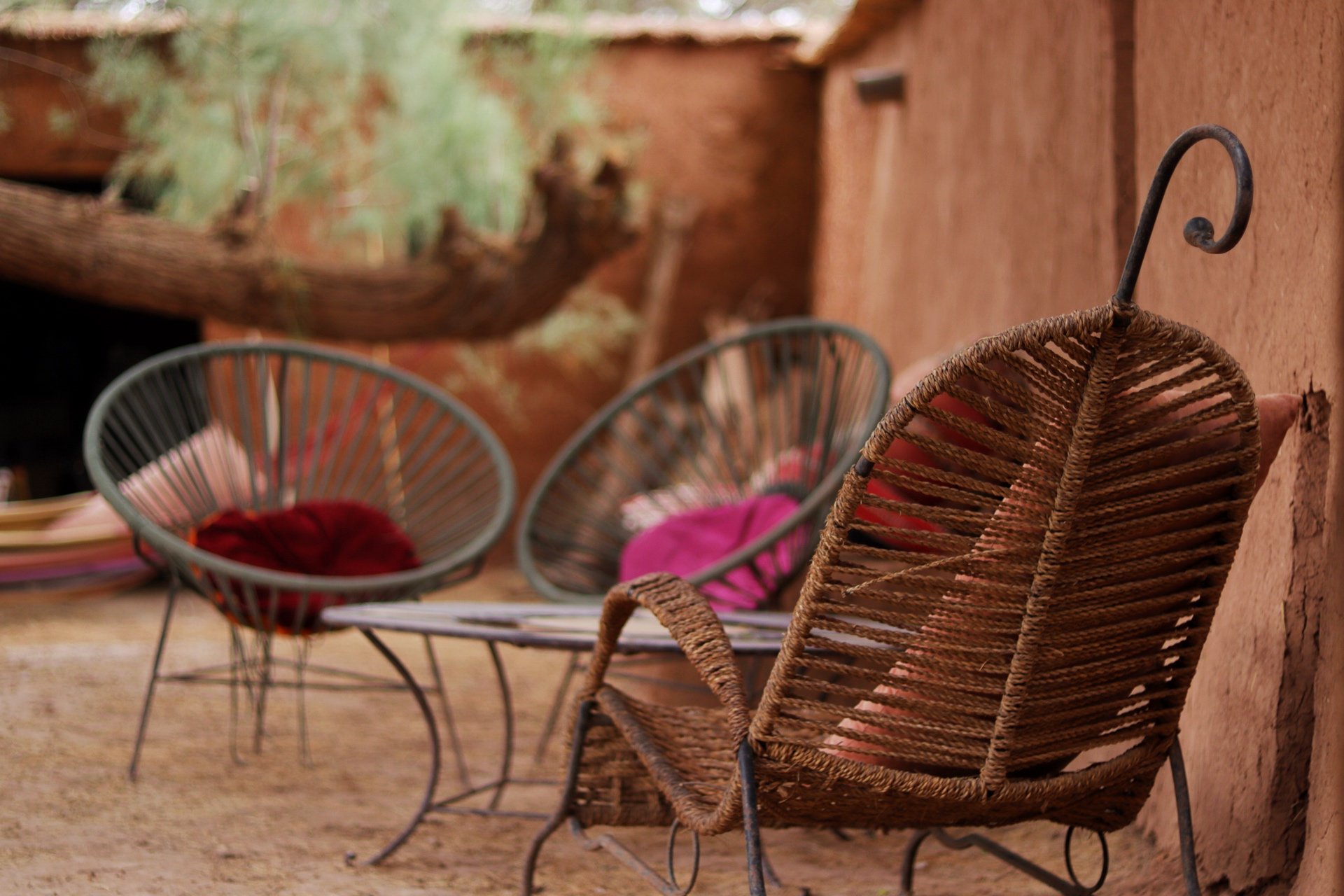
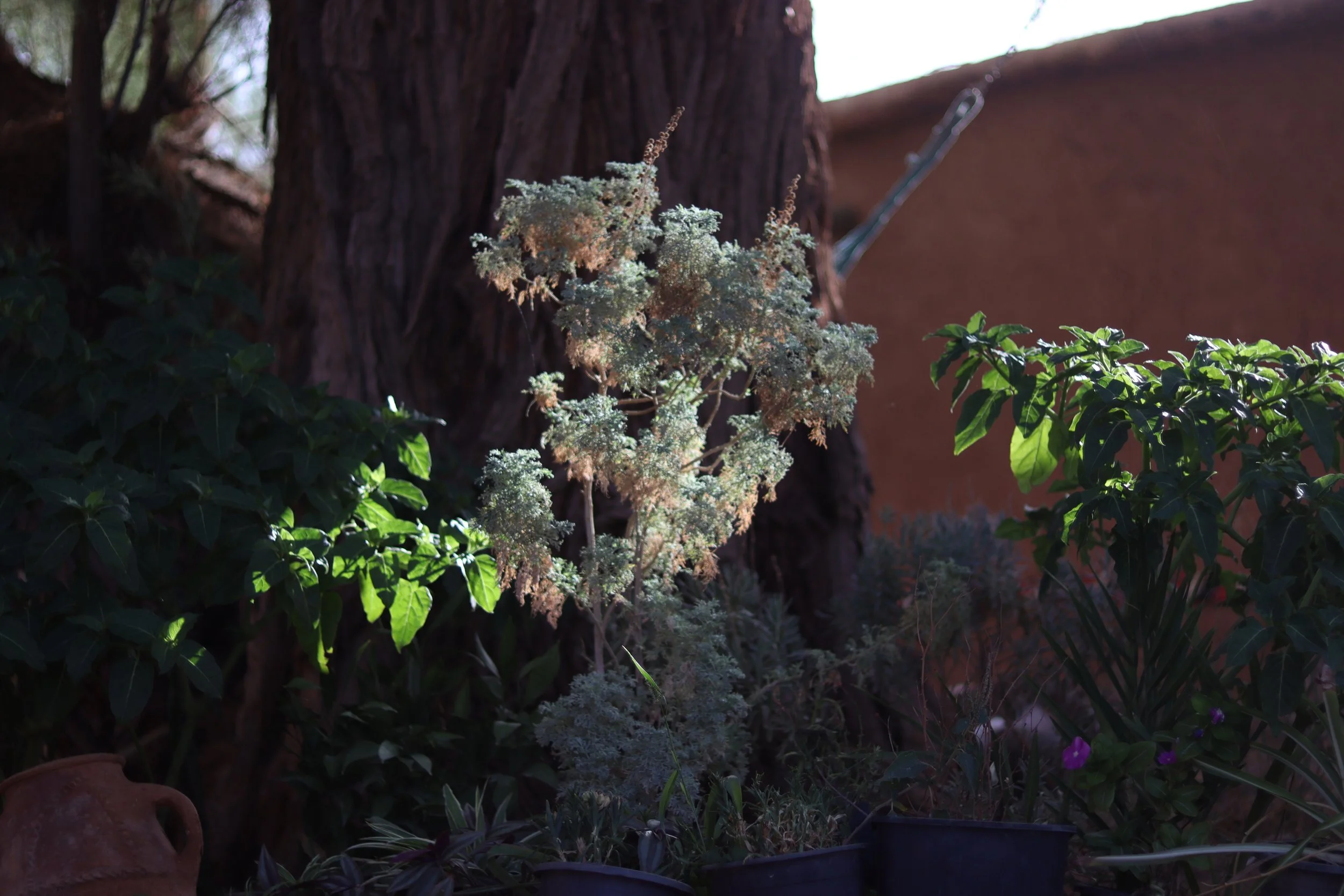
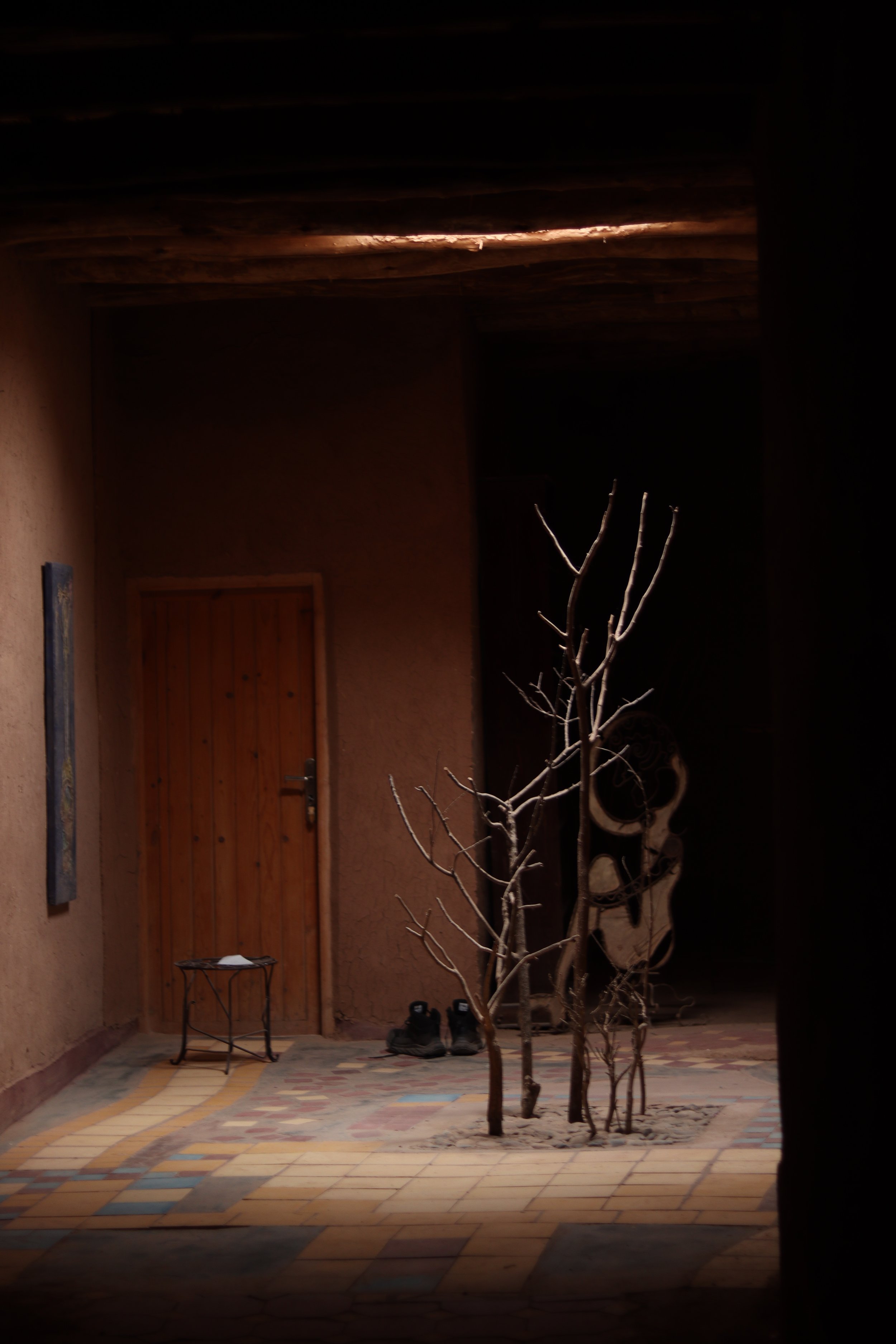
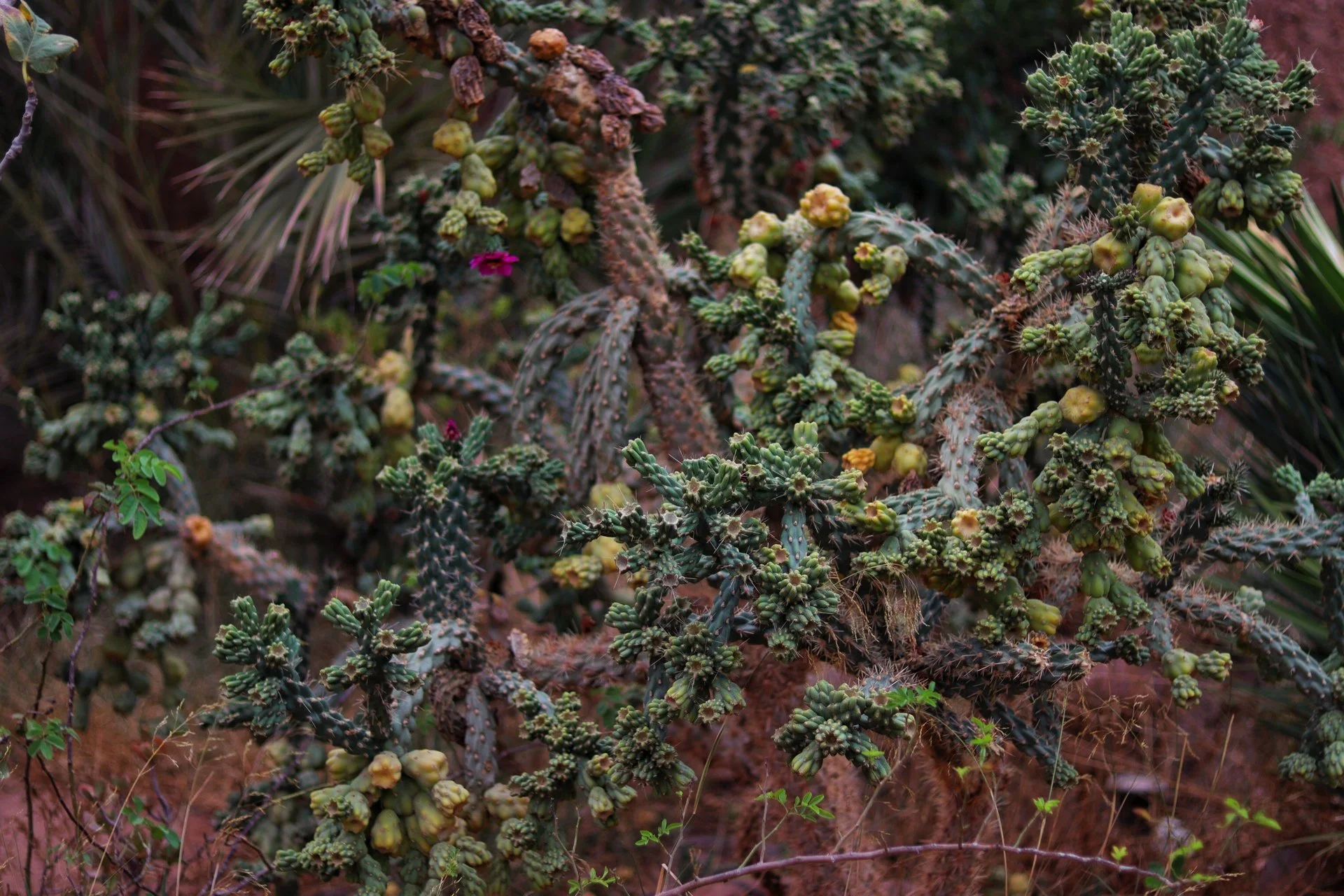
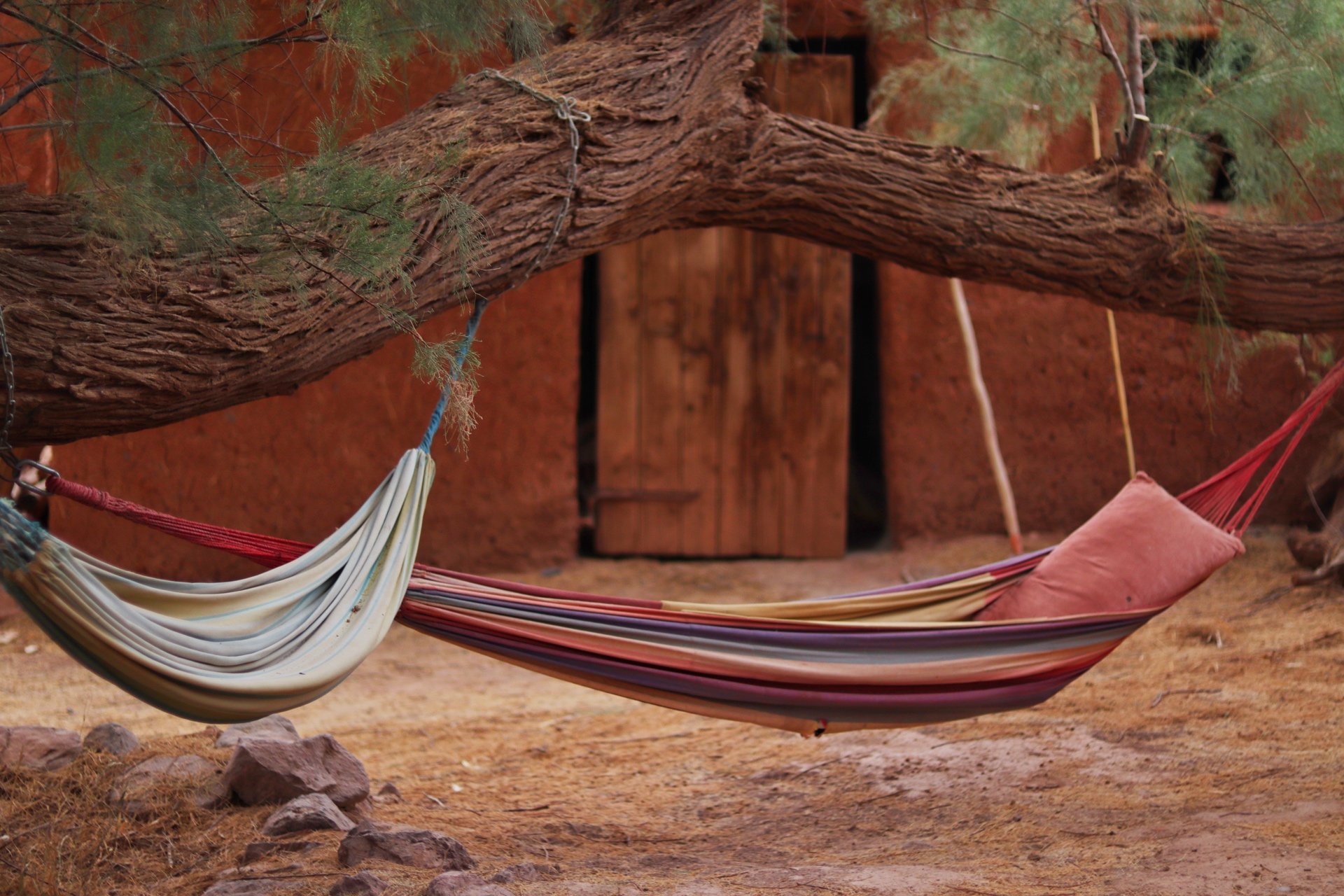
In that time, he built this oasis of a home in the far reaches of Ouarzazate, brick by brick (or more accurately, straw by straw). It’s a paradise — handcrafted with local materials, built around a courtyard filled with green prickly plants and one giant, beautiful tree. Inside were skylights that allowed plenty of natural light, a full and modern kitchen, and tasteful design with books, tapestries, rugs, and art, most of which was locally made.
“Do you like living here?” I asked him. We were sitting in two chairs beneath the big tree.
“Here? Of course,” he said, his French accent thick. “But in Morocco? Not really. I mean, with the society. I don’t get along with the society.”
“What do you mean?”
“Many people here think too much in the short term, to me,” he said. “They don’t seem to care about nature. About animals. About the cosmos. About their own history. They get trapped into thinking in terms of money. Even from their history, they don’t care about it,” he said. “They just use it to make a profit.”
As Eric said this, he didn’t sound bitter, even though the words may come out that way. It was more like an observation. And of course, it was just his perspective.
This was the piece though that I needed to hear — not to condemn the place, but to get permission in a sense for how I was feeling. I felt I was hopelessly stuck in this tourist circuit; and that the real Morocco existed just over there, just out of my reach. I was questioning my decisions as a traveler, and whether I was spending my time wisely, doing enough research, talking to enough people — i.e. making enough of an effort to reach that “real Morocco” that I felt was so within my grasp.
But no, that wasn’t the case. As a tourist, I felt like a cash grab, not a human being. I was getting jaded rapidly because I was taking all of this personally, but hearing it reflected by someone else brought relief. Tremendous relief.
And it’s paradoxical, given Eric is here as a foreigner, making money off the land. But is it? Through him, taxi drivers are making nice wages. Eric hires his neighbor to give tours along the trails. Years back, he launched a website so the village women’s carpets can have a broader market — and now, they’re sold all over the world.
Eric worked in an organization to help, and left after being too frustrated. You can live in a place and disagree with its values. We in America do it all the time.
Talking with Eric was a delight. He had a wonderfully grounded perspective on all things, especially as we moved into American & European politics. But when you meet a 60-ish-year-old man living by himself in the far reaches of Morocco, one cannot help but wonder: Is he truly happy here?
“I love the plants, the stones, the animals,” he said, “I love the quiet. I cannot go back to France. This is my home.”
That night, I’d meet Dianna and Salem, the two other guests. It’s funny, I go to the tiniest village, outside the smallest town, and I have my best conversations.
Dianna and Salem were, I’d guess, in their late 50s. I liked them as soon as I met them. She’s American, he’s Scottish and Pakistani, they met while working at the United Nations. Eric cooked us a fabulous vegetable tagine with bleu cheese and fried rice, plus homemade bread and an olive and cheese spread. I asked how they met and I got a most wonderful story.
Dianna was married with four kids. She’d met Salem at a work conference in New York. They were both married, but stayed in touch. One day, years later, Dianna was dropping her youngest off at college and she got a call. Her birth mother had a heart issue — and in her semi-lucid state, requested she meet Dianna (Dianna was an orphan, left as a baby at the Salvation Army and raised in a foster home, then with adopted parents).
When Dianna’s mom came to, she relented and said she didn’t want to meet anymore. “That didn’t matter, because I was going anyway,” Dianna said.
Her Mom lived in Tennessee. She had seven kids total, four of whom she gave away. They eventually did meet, and in doing so, Dianna also found out where her birth father was living; or rather, she learned the high school where he went. She called and they said he was in California. “But also, sweetheart,” the school said, “he’s homeless.”
“We agreed to meet at a diner,” Dianna said. “And actually, he was way more put together than I thought. In high school, he was a surfer dude apparently. But I noticed something: he kept calling everyone in the restaurant ‘brother.’
“We found out he was a member of the Brotherhood of Eternal Love. They were responsible for bringing the first acid into the United States, from Afghanistan. They’d ship trucks and hide it in the sides of the vehicles — or mostly, inside their surfboards.”
Salem chimed in. “At a Jimi Hendrix concert, they flew a plane and dropped 2,000 tablets of acid over the crowd.”
“So yeah,” Dianna said, “that was my Dad.”
“After, though, my life completely changed,” she said. “It was like this cassette tape in my head just stopped. With my husband, I just couldn’t go on. He wanted the status quo. He wanted country clubs, living a certain predictable lifestyle, and I just couldn’t do it. And I told him, ‘I crossed through something, and there was no way I could go back.’”
She and Salem had originally met through the UN. They were both married, but remained in touch via email. After the separation, Dianna reached out and they started corresponding again. That was 15 years ago and they’ve been together ever since.
“It’s like a Benjamin Button relationship,” Salem said. “It gets better and better every year.”
***
The next morning, we all gathered for breakfast. Eric again filled the table with food: bread, pancakes, eggs, fresh fruit, coffee and cheese. These were the best and healthiest meals I’d eaten in Morocco thus far.
They asked about me and I told them a bit of my story. I shared how I have my blog, it’s been this labor of love, but when I’m back, I want to turn this story into a zine, in printed material. I said I don’t know exactly what I want to do next work-wise, but I’d love for it to look something like this, a mixture of travel, exploration, and writing.
“What’s keeping you from doing it, like full-time?” Salem asked.
“You mean this, like just writing zines?” I asked, a little flustered. “I need a way to make money.”
“I’ve got two pieces for you,” he said. “One, do what you love. Full stop. Nothing even really needs to be said after that. But two, you need surprisingly little money to live.”
“A successful life is when you do what you love, you can live comfortably, and you aren’t beholden to anyone,” he continued. “My whole life, I always chased bigger incomes. Then I realized it’s not about that — it’s about lowering your expenses.”
“You live in New York, pricey place,” he added. “But there’s many other places to live where you can afford this lifestyle. Right now.”
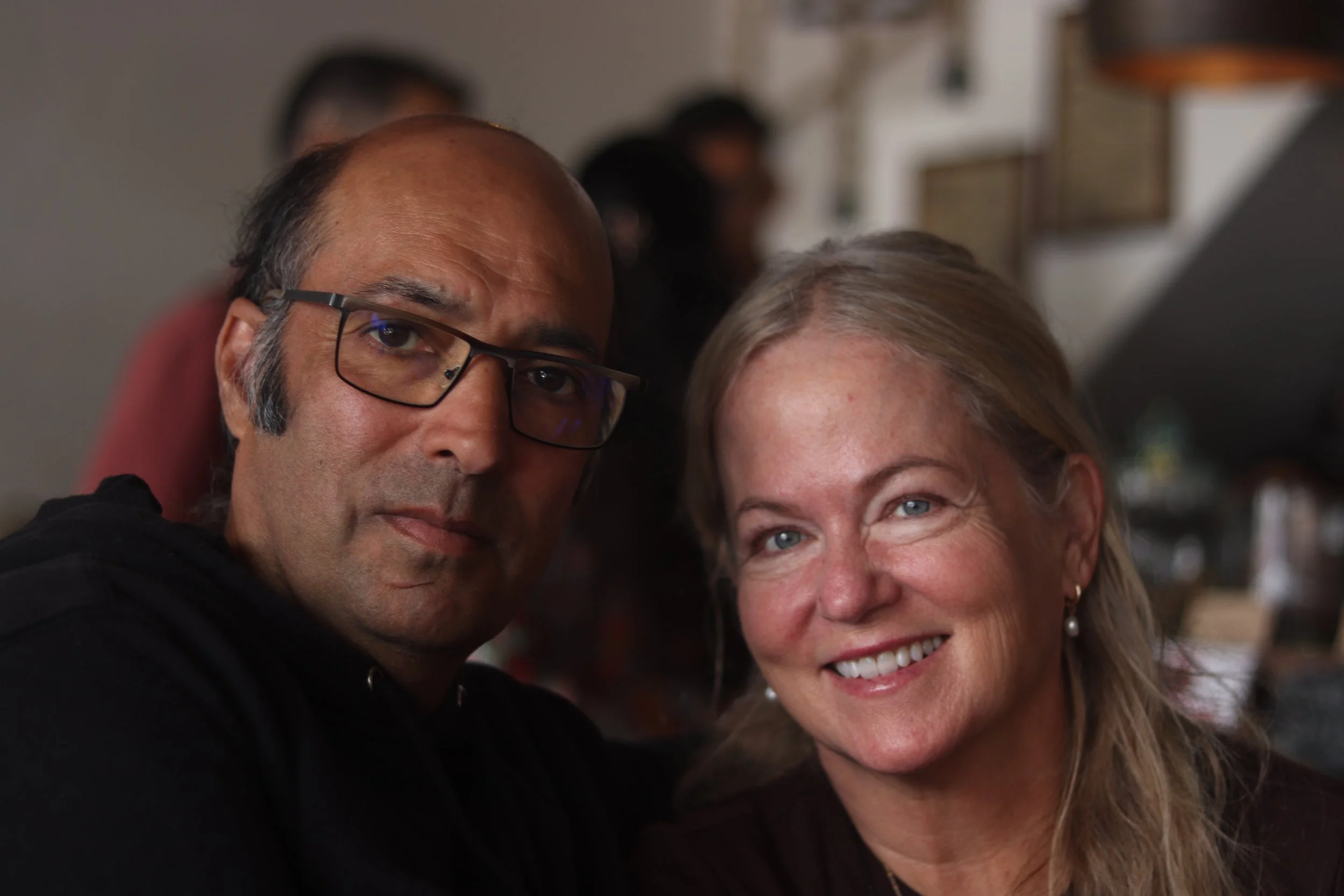
Salem & Dianna. Note: this pic was taken when we serendipitously met up later in Essaouira (spoiler). I only say this to note, this was not taken at Eric’s.
That day, I had no plans. This was kind of freaking me out, as I was in a village of 30 people and I was afraid of boredom. Dianna and Salem were going for a hike, and I was secretly wishing they’d invite me, but alas, they did not.
That said, it’s not hard to do nothing at Eric’s. I actually found it quite peaceful, once I leaned into it. I read my book. I drank my coffee. I wrote. And when I got restless, I walked out the back door for a hike, as Eric has tons of trails behind his home.
As I walked, my mind drifted, and I started thinking back to that taxi ride in Chefchaouen, where I felt that desire to teach. I’d regarded it more as a happy thought than life-changing clarity, as I still saw myself becoming a documentary photographer, not a teacher. But I’m learning, when something grips you like that, with a mix of clarity and emotion, even if it’s short-lived, it’s far from meaningless.
I started thinking of some past experiences, “signs.” They were always there. When I was in doubt, or questioning my path, teaching was the thing I’d often came back to, and I always thought of a reason for why it wouldn’t work.
I thought of when I was staying in Mexico, four years back. Again, I was considering leaving copywriting, but not sure what I’d do next. I met this guy at breakfast who said, “Your next thing might not exist yet, because you haven’t seen what it is.” As in, my next job didn’t exist in the conventional sense, but I’d have to see an example of it. That very afternoon I was walking and this woman I’d never met before stumbled onto my path. It was wild to meet a stranger, especially a foreigner, as I was in a very, very small village where you knew everyone. She was an author, she said. She wrote her first book when she decided to teach English in China. She learned of folktales from her students, then compiled them into a book, and continued to do that in each succeeding country. And then, like an apparition, I never saw her again (I still don’t know if she was real). After I met her, lightning surged through my body. That’s it, I said to myself. That’s what I want to do.
But again, for some reason, I explained it away.
Yet now, here, as I reached the top of this mountain, I thought of being in the classroom, of coming up with creative lessons, of connecting with and learning from my students. I thought of the activities we’d do, the stories I’d share, the ways my marketing skills could translate into holding a classroom’s attention. That excitement grew more and more, and I started thinking about graduate schools back in New York or teaching certification programs. And by golly I kid you not: As I had these thoughts, I received an email from the Teacher’s College in Columbia University offering an open house.
Well, God, say no more.
I’m listening.
***
Eric seems like a happy guy. He loves plants, animals, rocks, and cooking. I think Eric is happy because he’s doing the things essential to happiness: learning, building, serving, and connecting. He also loves where he lives. This is why I think Eric is happy.
Often I assume, for a person living alone, without a partner or kids, that he’s sad, bitter, or running away. But when you meet Eric, that’s not the case.
When I first had tea with him, he shared a slice of his story — the NGO, then starting his own, etc. But on our second night, as we all nibbled on our dessert after another fabulous meal, Eric told us his story in full.
“I wanted a big change to happen in my life, something huge,” he said. “I was tired of my life, my NGO. And I met this boy. He was two, living in the home of this woman, whom I later found out was a prostitute. I felt this strong connection with the boy, I can’t really explain it. I kept seeing him and kept visiting him. The woman noticed this, and one day said I should keep him. I was floored. ’Wait, you aren’t the mother?’ I asked her. No, she said. She was just taking care of him, and had no idea where his mother is. So I took him with me, and it changed everything."
“It was just me and him. With him, I had to stay in Morocco, I couldn’t go back to France, or anywhere else. We lived without electricity or water for five years, and they were amazing,” he said. “Those years were perfect.”
“I moved into this village, and everyone at first would stare at me,” he continued. “They knew me as the French man with the Moroccan boy. But eventually they accepted me. And so did the women in the village. I was so anxious with the boy, I had so many questions, and they were so helpful. The women took me in, they showed me everything."
“Now my son is married, he has a daughter. We don’t see each other much now, it’s strange. But when it all first happened, my mind was reeling. I knew, though, that I had to do it.”
Amidst this child-rearing, Eric had this home built. He found the land, spotted this big tree, and designed a home around it. He employed local builders and they used traditional methods, which would trap heat in winter and coolness in summer. He designed every bit of it himself, including this garden in the middle.
I thought back to that conversation in Sefrou, when Youssef told me about intention and benediction: “You can be isolated all the way in the mountains. But if you have benediction, you will succeed.”
Eric, metaphorically, is in the mountains. Yet he receives guests all the time from all over the world. He had a professional chef, who taught him how to remodel his kitchen. He had people who came to apprentice as rug weavers, learning from the women in the village. His psychiatrist friend in France sends patients for space and serenity. A dancer is hosting a creative retreat with ten guests.
It doesn’t make sense. It’s so far away, in a town Moroccans actively discourage tourists from visiting. And yet, here we are.
And now, the home takes all of Eric’s time: cooking, cleaning, gardening, serving. He has several side projects, including an online magazine about Berber culture that he doesn’t have enough time to populate. Eric does not meditate, but he is the essence of the Buddha: acting for the sake of, and expecting nothing in return. The home is in constant flux, never finished and in the best way. It is alive, a living home, surrounded by the power of nature, rocks, who hold the sacred energies of ancient cultures, built around a tree that roots the home.
It is a constant act of creating, and I don’t believe Eric is maintaining the home. Rather, the home is shaping him.
After the adoption story, Eric spoke at length about the building process: how the plan took shape, the challenges, the visions ahead. When the home was built, it was just Eric and a few local builders. One of them was a painter from Senegal. Throughout construction, Eric said, the man kept muttering this phrase to himself, over and over: Dans l'ordre de la lenteur du temps. Eric translated it into his phone, then said it aloud to me:
“In the order of the slowness of time.”
Oof.
Ugh.
Folks, believe me when I say, I was not looking for an epiphany. I mean, I’d just had the teaching one crystallize that very day. But when Eric said those words, in that particular order, they shot straight into my brain and melted everything.
In the order of the slowness of time.
I could barely speak. I was doubled over, repeating the phrase to myself over and over.
In the order of the slowness of time.
I need to share a little context. I did not mention this, but I was in a relationship at this time. It was wonderful and transformative in many ways, but throughout this trip, we were fighting a lot and I was having doubts about its future.
So when Eric said this line, immediately, in the space of milliseconds, I thought of her, and I simply knew with astounding clarity that this relationship was going to end. I also knew though, because of this quote, that it needed to play out — even if I knew it was doomed, I had to see it through. And if I didn’t, the experience or lesson or whatever was happening would not be complete.
It’s hard to explain, but it all made sense in that moment, in a flash. The word “evolution” then came to mind, and I had a whole new understanding of it: I saw life as a series of squares — that each square represents an event, whether huge or mundane, but that each square needs to happen in its proper order. You can’t skip one, nor can you make it play faster. The big thing can’t happen until all the little things happen before, for their own reason and their own purpose, at their own pace.
“If you don’t get this, you will fail,” Eric said. “It is the order of the cosmos. It is everything.”
“That’s why I love stones,” he said softly. “They know this.”
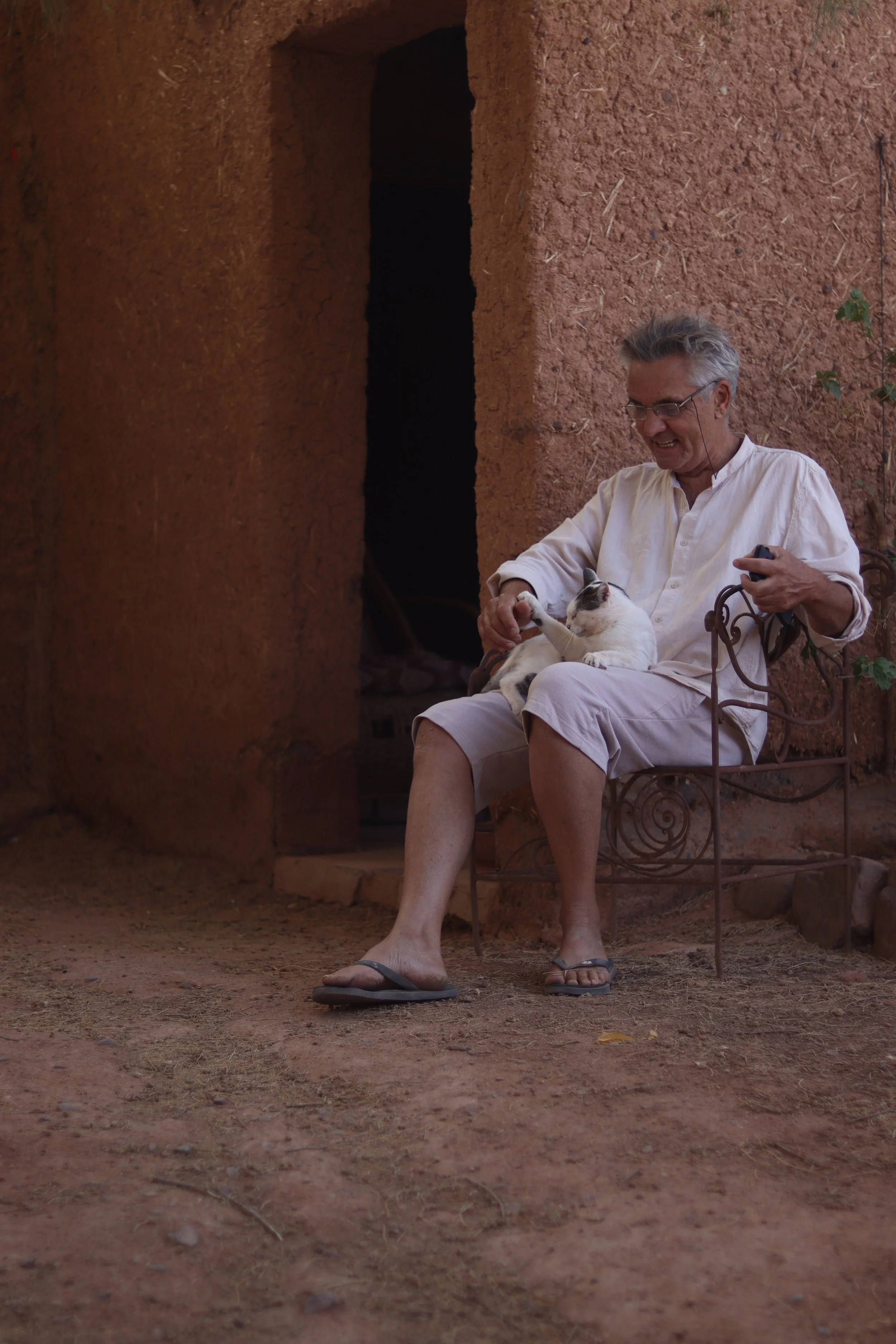
Eric
MARRAKECH
As I said, I came to Marrakech for a blue wall.
It’s what planted the idea of Morocco many months before. My friend Lexi, who’s story of exodus first launched my quitting, knew of this blue wall from the start. And so I had to update her on what happened. This is the voice note I sent upon arriving (or not arriving) at the blue wall.
Hello Lexi. So I send this message with mixed feelings. I got to the blue wall. And guess what? I went to the wrong place. I was gonna go to this blue wall. I mean, this is what brought me halfway across the world. I gotta pay homage. I just need to like, touch it. Or like take a picture.
I think we both recognize the absurdity of this wall. I first saw it on my friends Instagram. That’s the image that stuck in my head. And I saw it was at the Yves Saint Laurent museum. So I hoofed my way over. I know nothing about fashion. I paid a lot for the ticket, by both Moroccan and American standards. So I go through this museum, I’m like, I don’t get it. Ok, it’s kinda cool but it’s all in service of this wall. And I get to the end and I’m like, oh my god, its at the garden next door. I went to the wrong wall. I’m outside the garden right now. I can’t see the wall. There’s a tremendous line of people. And I have no interest in going inside.
Maybe there’s a metaphor or life lesson in this. But I don’t know what it is.
In the interim, there’s a cafe nearby, and they have a blue wall. So maybe I’ll just go there, take a picture of their wall, and call it a trip.
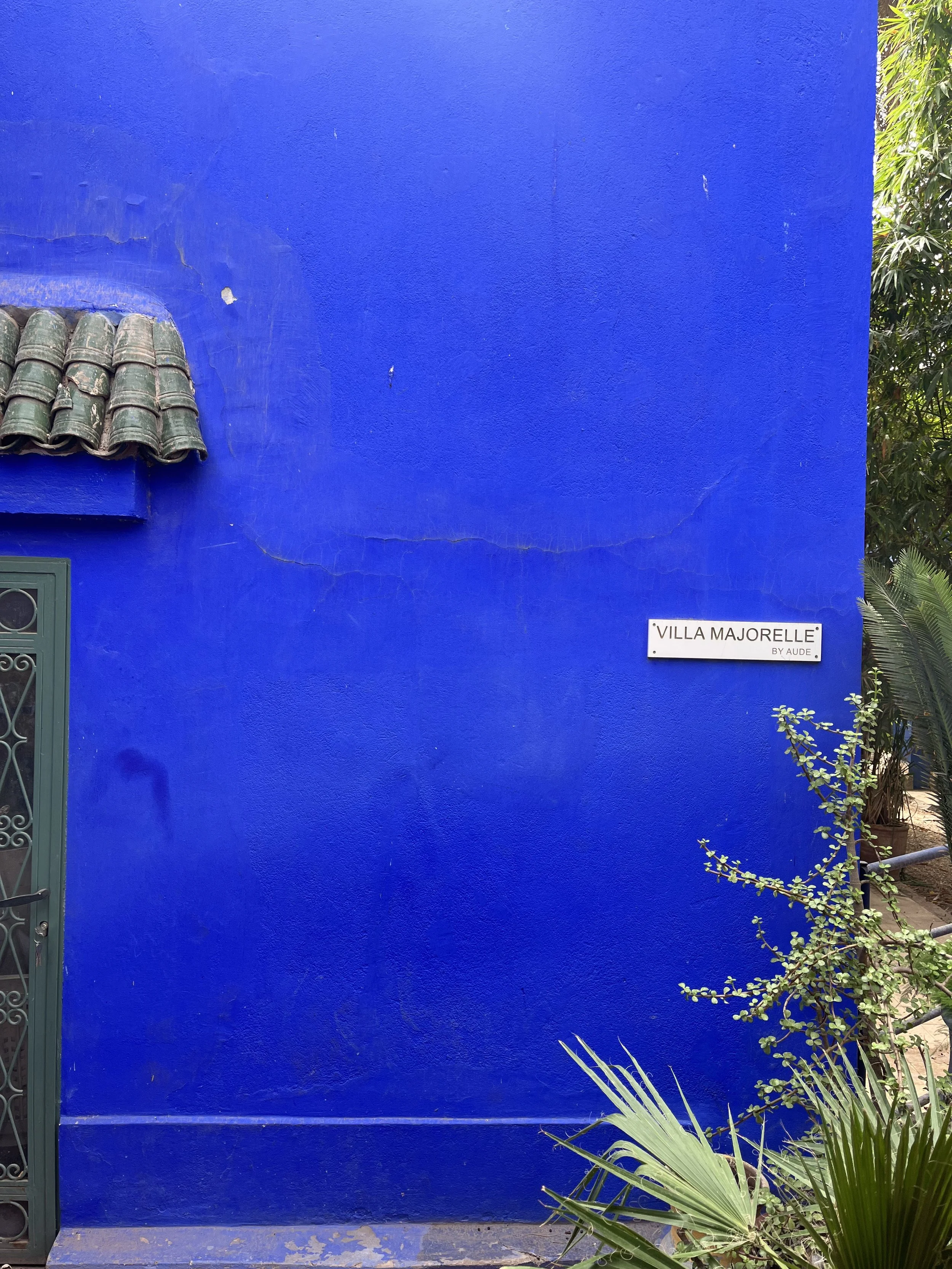
A wall
That night, I met a photographer for tea. He’s a friend of Eric’s and his name is Karim. He was raised in Ouarzazate.
We met under the pretense that I’d pick his brain about documentary photography. I checked out his work before and it was magnificent. It took about ten minutes however to learn that that wasn’t a conversation worth pursuing. “Photography is my job,” he said. “I don’t even take my own pictures any more.” Peace, for him, was photographing a luxury hotel room, where he could control the lights, the set, and all the variables, and shoot in silence.
Karim was around my age, yet had a wife and kids. Photography, and life for that matter, had a certain practicality that mine didn’t. But everything loosened once the conversation shifted from work.
We talked first about politics, and about the mental grace of not reading the news. I’d remarked the Moroccan king looks strikingly like Jimmy Kimmel in some pictures, which he appreciated. But most of all, it was my first time sitting at the table and actually talking to a Moroccan person, one who wasn’t employed to talk to me.
So I asked about all the things I wanted to ask — most of which, about the call to prayer, and what’s actually happening when those voices boom and bellow throughout the towns. “It’s a time for gratitude,” he told me. “It’s an opportunity to pause, to take a breath. To say thanks for the things you have in your life.”
I thought of the book Island, by Aldous Huxley, which was his vision of utopia. In it, there are birds in trees who constantly tweet “Attention.” This beckons you to be aware of your existence, your life, and not take any of it for granted. The call to prayer, I felt, is the Moroccan version of the birds in the trees. “I don’t pray all five times per day,” he told me. “But if I don’t do it at least once, something feels off.”
He then taught me of an Islamic concept, Baraka. Essentially, as I understood, it’s the prayer to be able to experience gratitude — as in, manifesting the capacity for gratitude itself. “You must be grateful for the little things,” he told me, “the things that, if you lost them, you’d be devastated. Your family. Your home. Your relationships. Your eyes. Your movement.”
“It’s the simplest ones you take the most for granted, the ones you think you’ll have forever,” he said. “These are what you must be grateful for.”
I told him about my time in Oregon when we experienced the wildfires. For five days, we had to stay inside, as the air was filled with toxic smoke. For those five days, what I wanted more than anything was to just take one breath of clean air. Clean air! The thing you never think about. You think that’s just a constant in life, like it’ll be there forever, and that’s not the case.
“There’s this story, a family is given a cup of juice. Baraka is the prayer that that juice is enough to sustain them, that they won’t need anything else,” he said. “Think of, if you only had one cup, you’d savor every sip. But if you felt it was endless, you wouldn’t enjoy it at all.”
“If you can’t appreciate that sip,” he told me, “you appreciate nothing.”
***
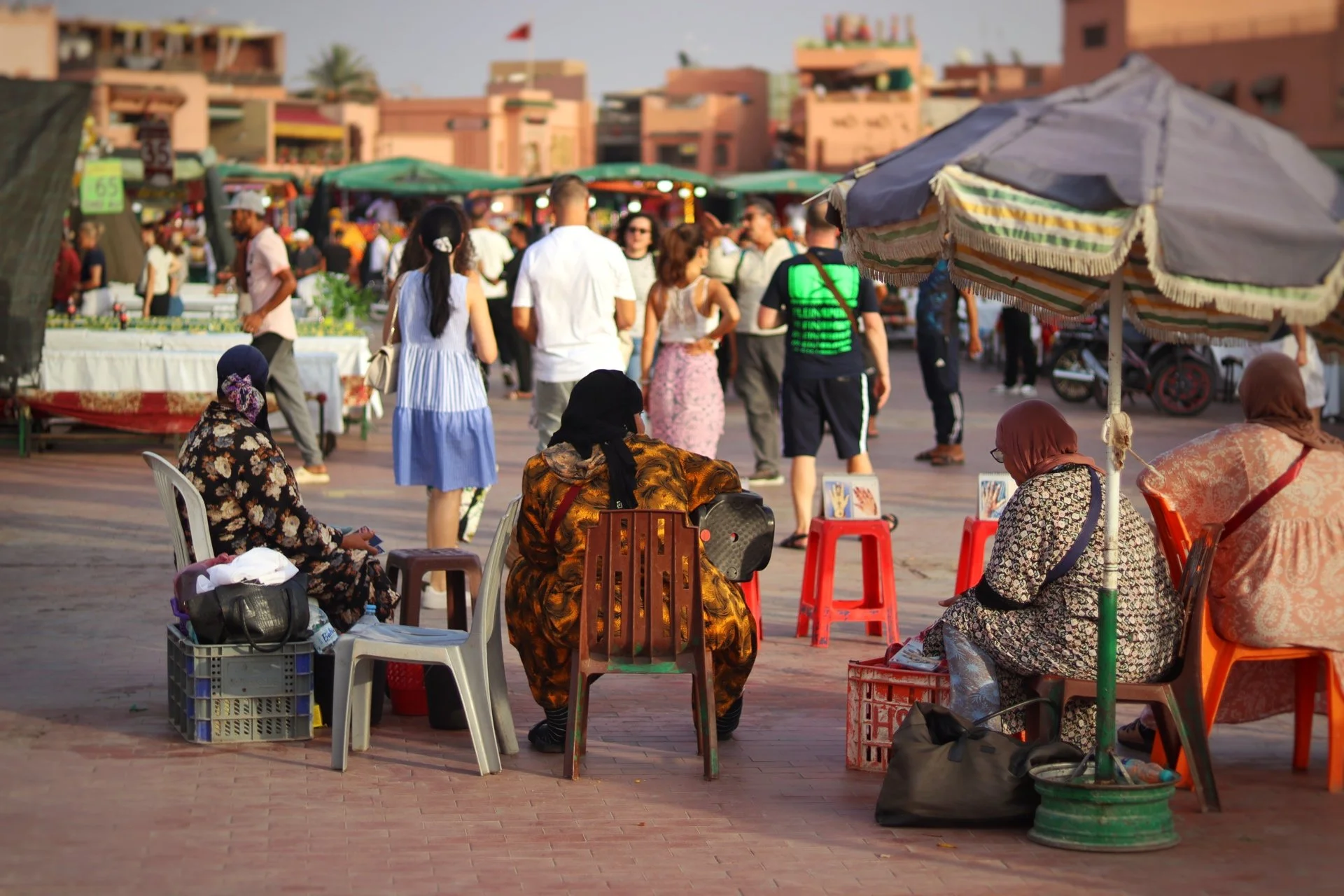
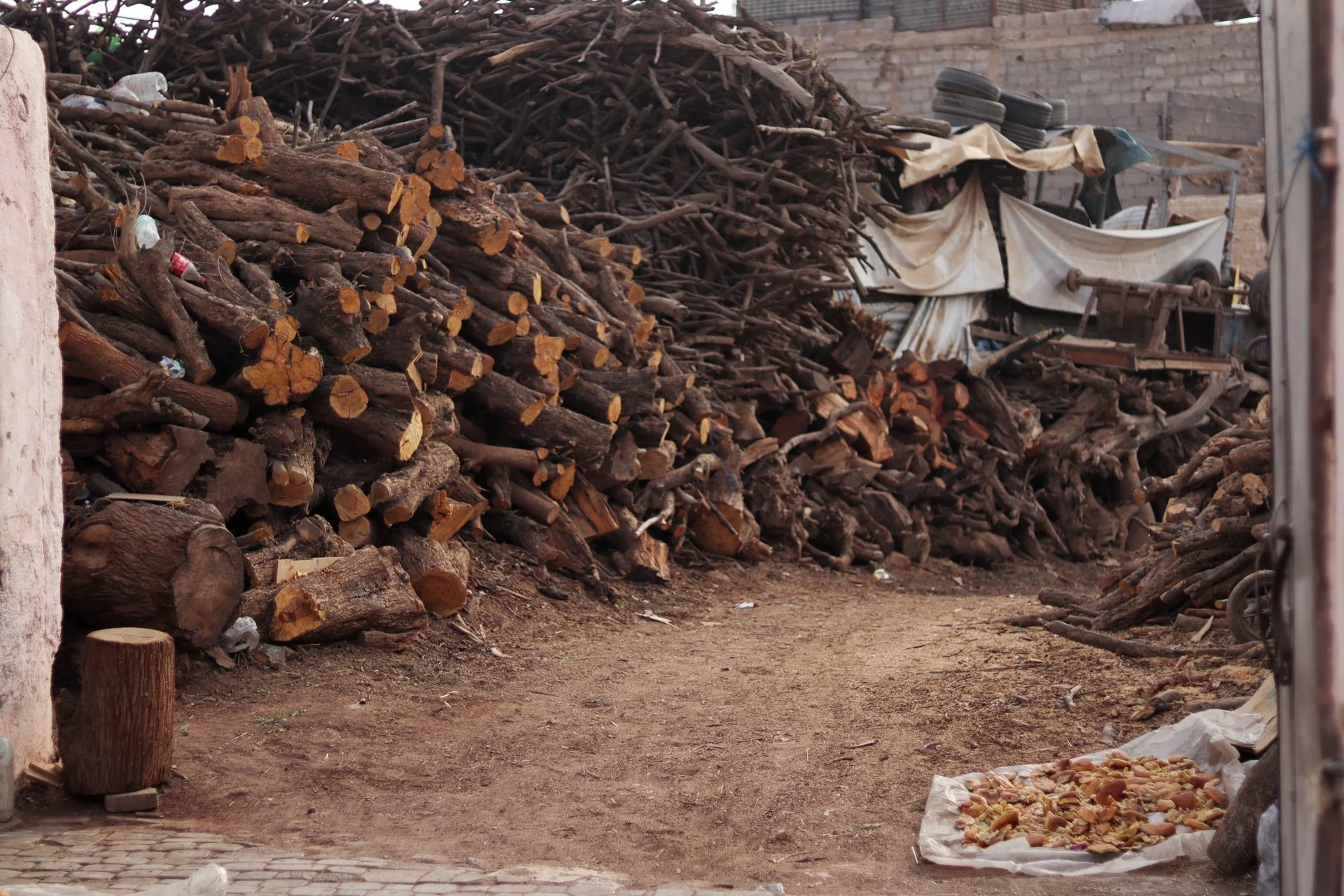
Marrakech was a buzzsaw. At first I loved it and then I didn’t. I mean, it was also a stopover city; I was there for the wall. Once that folded, I was done. It is quite buzzy though and you do get a sense of life there, beyond the tourist circuit: walking through the medina and scooters blasting full speed through the foot-wide alleyways, people hawking foods and goods, snake charmers, the like. It’s a veritable feast for the senses, that’s for sure.
Now that it’s said and done, I was heading for the coast. I had a good feeling about this.